The Daisy Co. Journal
Where yoga and Pilates actually came from
One is nearly three thousand years old and was barely about the body at all. The other is about a hundred, and was invented by a man locked up on the Isle of Man. Here is how both of them ended up in a studio near you.
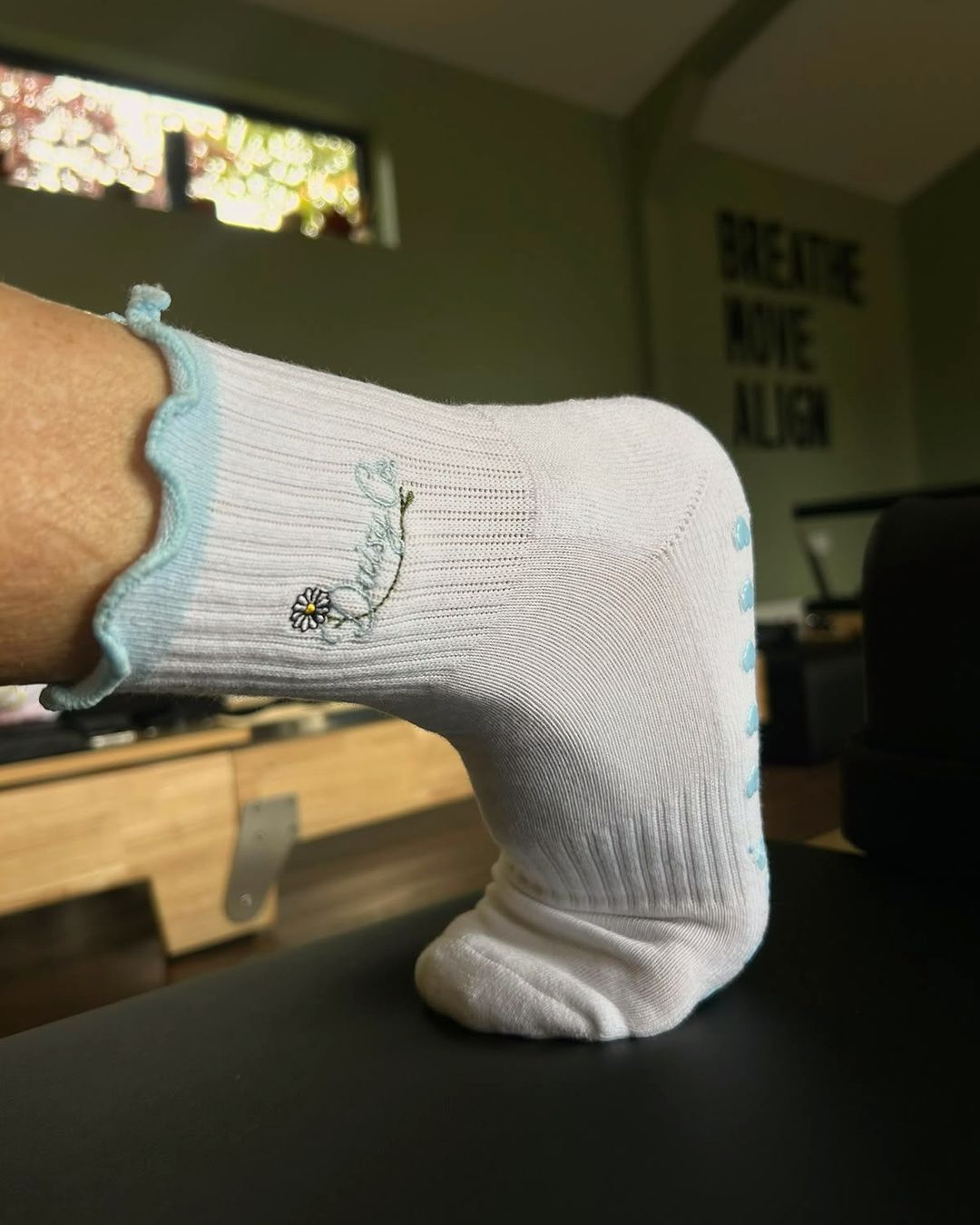
Guides
Short and practical. Or read on below for the long story.
If you have ever stood in a reformer studio at seven in the morning, gripping a footbar and wondering who thought of this, the answer is stranger and better than you would guess. Two practices, invented for two completely different reasons, on two different continents, roughly two thousand years apart. Neither was designed for the room you are standing in. Neither was, at the start, really meant for women at all.
And yet almost every studio on your street teaches one or both, and the rooms are full of women. That did not happen by accident. It happened because in both stories, at the exact moment the practice could have stayed a private, largely male discipline, a woman picked it up and carried it out into the world.
So here is the long version, as a timeline. Make a cup of tea.
Part One
Yoga
Roughly three thousand years, of which the part you would recognise is about ninety.
A seal in the Indus Valley[1]
Archaeologists digging the cities of the Indus Valley found small carved seals, one of which shows a seated figure with its legs folded and its heels together. For a long time it was held up as the oldest picture of yoga in existence.
Historians argue about this one, and the honest answer is that nobody knows. It is a seated figure. Whether it is a yogi, a god, or a person simply sitting down, the carving does not say.
The word turns up, but not the practice[1][2]
The Rigveda, one of the oldest surviving texts in any Indo-European language, uses the word yoga. It comes from a root meaning to yoke, as in yoking an animal to a cart. It is about discipline and harnessing, not about touching your toes.
The Upanishads and the Bhagavad Gita[2][3]
Here yoga becomes something you actually do. The texts describe it as a discipline for steadying the mind and understanding the self. Still almost entirely internal work. Still nothing you would call a class.
Patanjali writes it down[2][3]
The Yoga Sutras set out the eight limbs of yoga: ethics, self-discipline, posture, breath, withdrawal of the senses, concentration, meditation and absorption. It is the single most influential yoga text ever written, and scholars still cannot agree on when it was composed.
Here is the fact that surprises everyone. Out of 196 verses, posture gets a handful of lines. That is it. The thing that is now the entire visible practice, the shapes, the flow, the mat, is a footnote in the founding document. Yoga was a philosophy of the mind that happened to mention sitting comfortably.
The body finally gets a manual[4]
The Hatha Yoga Pradipika, compiled by Svatmarama, is one of the first surviving texts to describe physical postures and breathing techniques in real detail. Hatha yoga is still a niche within a niche, practised by ascetics, and nothing like a mainstream pursuit.
Krishnamacharya, and the invention of yoga as we know it[5][6]
Tirumalai Krishnamacharya, teaching at a yogashala inside the Mysore Palace under the patronage of the Maharaja, develops a flowing, athletic, physically demanding style. He is widely called the father of modern yoga, and the description is fair: almost every posture-based style practised today traces back through him.
Four of his students carried it out: B. K. S. Iyengar, Pattabhi Jois, his own son T. K. V. Desikachar, and one other.
A woman is admitted, and it takes a king to arrange it[7][8]
Eugenie Peterson, born in Latvia, had moved to India and taken the name Indra Devi. She asked Krishnamacharya to teach her. He refused. Yoga was not taught to women, and it was certainly not taught to foreign women.
The Maharaja of Mysore intervened on her behalf, and Krishnamacharya relented. She became his first foreign female student, and the first woman in that lineage.
Keep this date in your head. Every yoga class you have ever walked into, full of women, sits downstream of one person being let through a door in 1938.
Shanghai, then Hollywood[7][8]
Devi opened a school in China, then moved to the United States and opened a studio in Hollywood in the late 1940s. Her students included Gloria Swanson and Greta Garbo. Film stars did yoga, magazines wrote about it, and within a decade it had gone from an Indian discipline almost unknown in the West to something a woman in California might do on a Tuesday.
Light on Yoga[9]
Iyengar publishes the book that becomes the standard reference for postural yoga worldwide, precise about alignment in a way nothing before it had been. Yoga now has a canon, a vocabulary, and teachers being trained in it everywhere.
Everywhere
Studios, teacher training, leggings, festivals, a class in every gym in every town. The version the world practises is overwhelmingly the physical one, which is to say it is Krishnamacharya's, which is to say it is roughly ninety years old sitting on top of a three thousand year old idea.
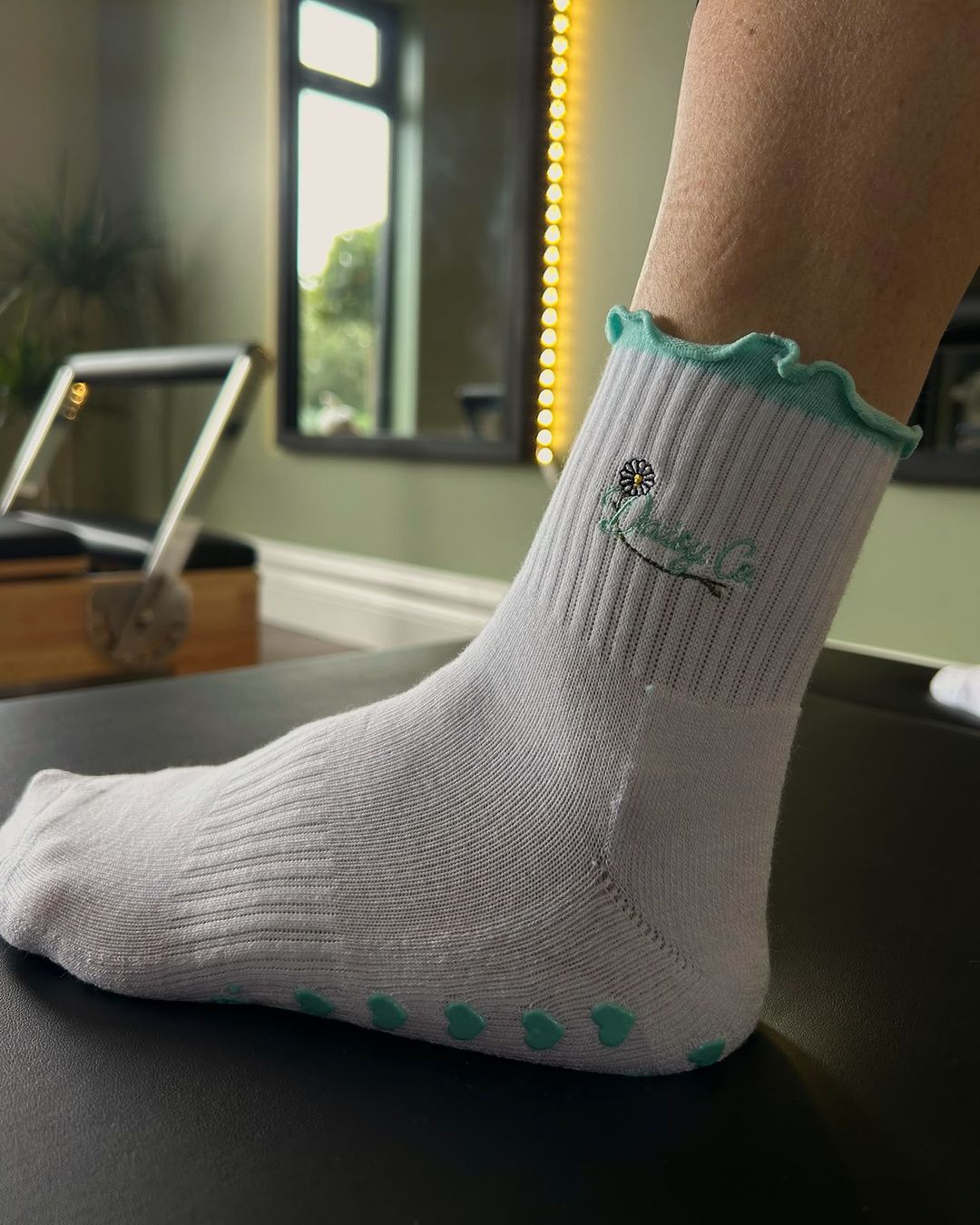
Physical fitness is the first requisite of happiness.
Joseph Pilates, Return to Life Through Contrology, 1945
Part Two
Pilates
One man, one internment camp, one wife who ran the place, and one court case that changed everything.
A sickly boy in Mönchengladbach[11]
Joseph Hubertus Pilates is born in Germany. By every account he is a frail child, and the frailty is the whole origin of the method: he spends his youth working out how to build a body that does not let him down. Boxing, gymnastics, wrestling, self-defence, whatever he can get at.
England[10][11]
He moves to England, working as a boxer, a circus performer and a self-defence instructor. Two years later the First World War breaks out, and he is a German national living in Britain.
Interned on the Isle of Man[10][11]
He is interned as an enemy alien, held first at Lancaster Castle and then at Knockaloe camp on the Isle of Man, where the records place him from September 1915 to March 1919. He keeps training, and he keeps training other men.
The famous story is that he worked on the hospital ward, and rigged springs to the bedframes of men too ill to get up, so they could work against resistance while lying down. That, the story goes, is the ancestor of the reformer.
It is a wonderful story and it may not be true. Knockaloe's beds are recorded as hard straw, which does not leave much to attach a spring to. Take it as the founding myth rather than the founding fact. What is not in doubt is that four years in a camp is where he worked the system out.
Contrology, and the Universal Reformer[11]
Back in Germany he keeps building. He calls the method Contrology, and the name tells you what he was after: the whole body moving together under conscious control, rather than muscles trained one at a time. He builds a sprung apparatus he calls the Universal Reformer, named because it was meant to reform the body.
Every reformer in every studio today is a descendant of that machine, and it is still called a reformer for exactly that reason.
A boat to New York, and meeting Clara[11]
He sails for America. On the crossing he meets Clara, who becomes his wife and his partner in every sense that matters. They open a studio at 939 Eighth Avenue in Manhattan.
Clara is the half of this story that usually gets left out. She co-taught daily, kept the books, handled the correspondence and ran the place. Joseph invented and refined and shouted; Clara taught, and by many accounts taught more gently and more patiently than he did. The method survived and got passed on partly because she was the one people could learn from.
The dancers find him[11]
939 Eighth Avenue happens to sit in a building full of dance studios and rehearsal space. Injured dancers start turning up. George Balanchine sends them. Martha Graham sends them. A method built by a boxer for general health becomes the thing that keeps professional dancers working, and the association between Pilates and long, strong, controlled bodies is set for the next hundred years.
He writes it down[11]
Two slim books, Your Health and then Return to Life Through Contrology. He is certain, in print, that he is decades ahead of everybody. He was right, and he did not live to see it.
Joseph dies[11]
He never saw Contrology become a global industry. What he left was a small group of students, later known as the elders, who had trained directly with him and Clara, and who spent the following decades teaching the next generation.
The court case that put a studio on every corner[12][13]
This is the beat nobody expects. For years one man, Sean Gallagher, held the United States trademark on the word Pilates, and pursued teachers who used it. If you taught the method, you could not legally say what you were teaching.
Balanced Body, the equipment maker, fought him. In a 93 page opinion, Judge Miriam Cedarbaum of the federal court in Manhattan ruled that Pilates is a generic word, like ballet or karate. It describes a method, not a brand, and nobody can own it.
This is genuinely why there is a Pilates studio near you. The explosion in studios through the 2000s follows directly from the moment the word was set free.
The reformer boom
Reformer classes go from specialist rehabilitation to the most oversubscribed booking in the timetable. A method a man devised to stop being ill, taught to dancers in a New York walk up, is now what half your friends do three mornings a week.
What the two stories have in common
Put them side by side and the same shape appears twice.
Both were built by people trying to fix themselves. Patanjali's yoga is a method for a restless mind; Joseph's Contrology is a method for a body that kept failing. Neither began as exercise in the sense we mean it, and both got narrowed down to the physical part on the way to us.
Both were closed to women, and both were opened by one. Indra Devi needed a maharaja to get through the door in 1938. Clara Pilates never had a door opened for her; she simply ran the studio while her husband got the credit, and taught most of the people who went on to teach everyone else.
Two practices invented by men, carried into the world by women, and now taught in rooms that are mostly full of them.
And both ended up in the same place: a warm room, a shared piece of equipment, and a teacher asking you to slow down and pay attention to something you normally do without thinking.
Which is roughly where we come in. If you have ever been asked not to go barefoot in a studio, there are two reasons, and neither is fussiness. One is hygiene, because the mat, the carriage and the footbar are shared by everybody who came in before you. The other is that a reformer carriage moves under you, and skin on a padded carriage is not grip, it is a slide waiting to happen.
That is the whole job of a grip sock, and it is why we cover the entire footbed in silicone rather than dotting the ball of the foot and calling it done. Your foot does not stay in one place on a reformer. Neither should the grip.
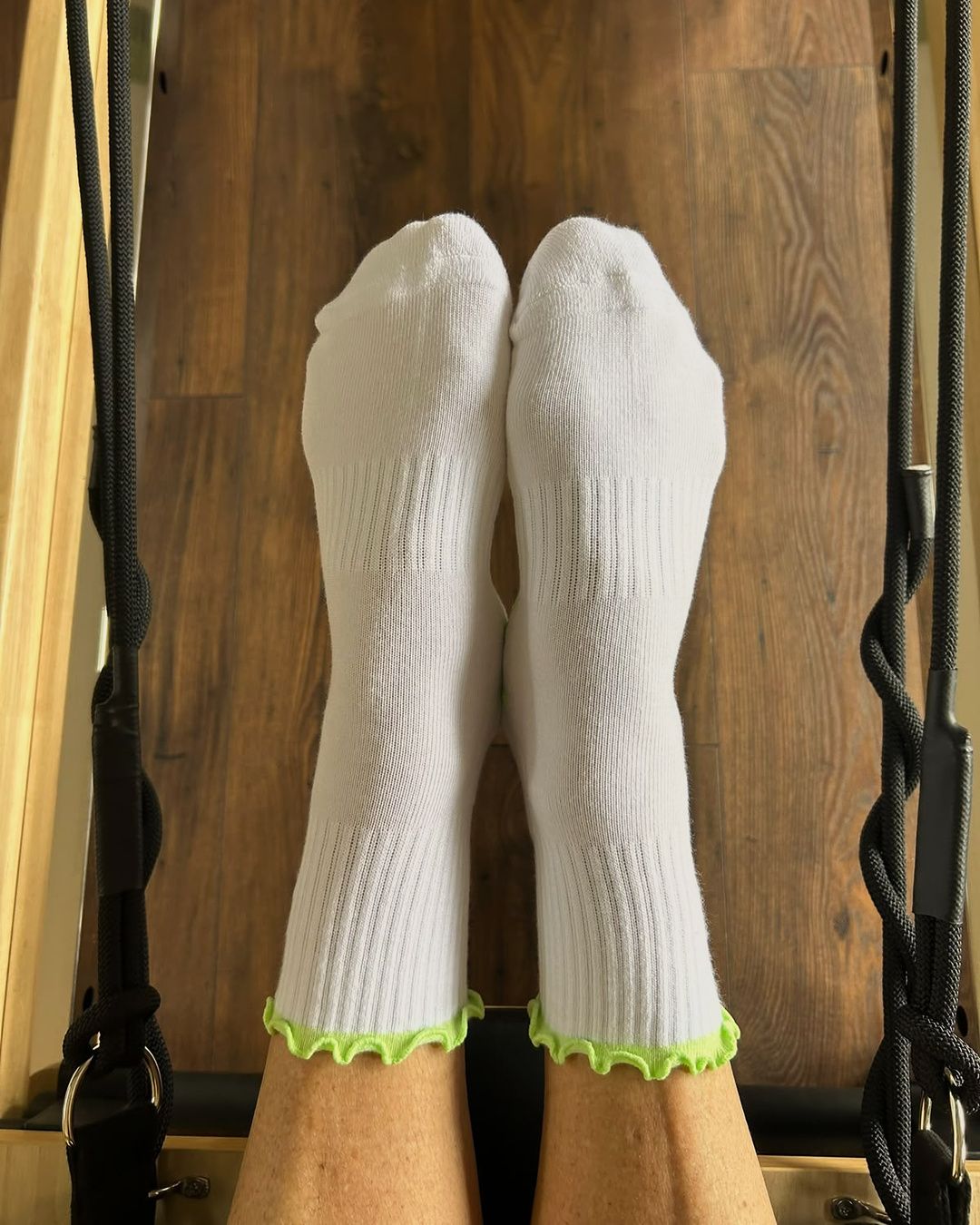
Made for the mat, and the carriage
Grip from heel to toe.
Eight colourways, full silicone heart grips across the whole sole, and a frill at the cuff because there is no rule saying studio kit has to be dull.
Shop the grip socksReferences
- Wellcome Collection, Yoga adapts to time and place. wellcomecollection.org ↩
- Encyclopaedia Britannica, Yoga-sutras. britannica.com ↩
- Internet Encyclopedia of Philosophy, Yoga Sutras of Patanjali, on the disputed dating and the eight limbs. iep.utm.edu ↩
- Hatha Yoga Pradipika, on Svatmarama and the fifteenth century dating. Wikipedia ↩
- Tirumalai Krishnamacharya, 1888 to 1989, and the Mysore Palace yogashala. Wikipedia ↩
- Yoga Journal, Krishnamacharya's Legacy. yogajournal.com ↩
- Indra Devi, born Eugenie Peterson, 1899 to 2002. Wikipedia ↩
- HuffPost, The extraordinary story of the woman who took yoga from India to the world, on the Maharaja's intervention in 1938 and the Hollywood studio. huffpost.com ↩
- B. K. S. Iyengar, 1918 to 2014, and Light on Yoga, 1966. Wikipedia ↩
- Knockaloe Charitable Trust, internee record for Joseph Pilates, giving his residency at the camp from 12 September 1915 to 16 March 1919. knockaloe.im ↩
- Pilates Method Alliance, Pilates History, for the birth date and birthplace, the internment with his circus troupe, Contrology, the dancers, both books and his death in October 1967. pilatesmethodalliance.org ↩
- Pilates, Inc. v. Current Concepts, Inc., 120 F. Supp. 2d 286 (S.D.N.Y. 2000), No. 96 Civ. 43, decided 19 October 2000, Cedarbaum D.J. courtlistener.com ↩
- Balanced Body, The Pilates Lawsuit, the defendant's own account of the case. pilates.com ↩
A note on sources
Dates in the yoga section follow the mainstream scholarly range rather than any single tradition's account. Where historians genuinely disagree, notably over the Indus Valley seal and the dating of the Yoga Sutras, we say so rather than picking the tidiest version. Indra Devi's Hollywood studio is given as the late 1940s because sources split between 1947 and 1948, so we have not asserted either.
Two Pilates details are worth being straight about. The bed springs story is contested, and the page says so. And while the Pilates Method Alliance confirms the birth, the internment, the dancers, the books and the death, it does not state the 1926 crossing, the meeting with Clara on the boat or the Eighth Avenue address. Those three come from the widely repeated account rather than from an institutional record, so treat them as the story as it is told.
Spotted something wrong? We would genuinely like to know. hello@daisyco.co